
Understand the system’s purpose.
Develop the design through business context, customer journeys, capabilities, and a structured architecture method.
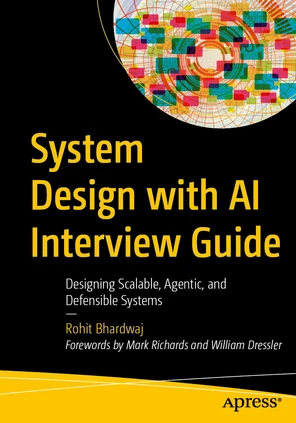
The book · Apress
Designing Scalable, Agentic, and Defensible Systems
By Rohit Bhardwaj
Build a structured approach to an unfamiliar design problem. Connect business goals to architecture, reason through AI and distributed-system constraints, and practice explaining the consequences of your choices.
24 chapters spanning system design methodology, technical fundamentals, and applied systems.
Book destinations open in a new tab. Availability and access are shown by the provider.
Browse the publisher’s contents and book details ↗Inside the book
For developers preparing for system design interviews and architects extending their design practice to AI systems.
Develop the design through business context, customer journeys, capabilities, and a structured architecture method.
Study AI primitives, trust, control, scale, consistency, latency, failure, and economics.
Work through architectures such as ride sharing, social networking, and e-commerce, then explain the trade-offs.
Explore the full table of contents on the publisher’s page ↗.
Use the book with the circle
Choose a problem, sketch your approach, and use AI to challenge it. Continue with a free guide, write down the decision in a worksheet, and bring a question to the live conversation.
A look inside the free PDF
Put a real design decision on the page. Start with the outcome, trace one interaction, and name what must remain true.
The complete worksheet adds constraints, alternatives, the recommendation, failure tests, and the evidence that would reopen your decision.
Free account required for the PDF. You can read this excerpt and every article without signing in.
Who needs what outcome? What is included in this decision, and what is outside it?
Trace one request from the user to the recorded result. Mark who owns the decision.
State the invariant or required behavior. Example: two overlapping bookings for one room cannot both be confirmed.
Read the prompts here. Use the PDF to record your own reasoning.
No. The live series and published learning resources are free to explore. The book offers a companion for deeper study.
Choose Amazon to view its purchase options, or O’Reilly to see the reading access available through that platform. Each provider shows its own current terms and availability.
Choose one design question from the resource library. Explain your approach aloud, write down a trade-off, and change one assumption to test the reasoning.